Largest-ever exhibition of precious Tang dynasty relics in Hong Kong

“Tang Vogue Beyond the Horizons: A Golden Era of Multicultural Integration and Openness”, an exhibition jointly presented by the Development Bureau (DEVB) and the National Cultural Heritage Administration (NCHA), is currently on display at the Hong Kong Heritage Discovery Centre (HDC) in Tsim Sha Tsui. Earlier on, a group of distinguished guests and I officiated at its opening and appreciated nearly three hundred invaluable Tang dynasty relics that are on loan from the Chinese Mainland and unearthed in Hong Kong. These include forty-nine pieces/sets of national grade-one cultural relics, most of which are being shown in Hong Kong for the very first time. This time, I have invited colleagues from the Antiquities and Monuments Office (AMO) of the DEVB to explain what makes the exhibition special.

The largest joint exhibition, in terms of profile, scale and quantity of artefacts on display

As one of the celebratory events marking the 28th anniversary of Hong Kong’s return to the Motherland, the “Tang Vogue Beyond the Horizons: A Golden Era of Multicultural Integration and Openness” exhibition is the largest joint exhibition, in terms of profile, scale and quantity of artefacts on display since the signing of the Framework Agreement on Deepening Exchange and Cooperation in the Field of Heritage Architecture and Archaeology between the DEVB and the NCHA in 2022, marking a move towards a higher level of mutual cooperation.

According to Ms Susanna Siu, Chief Heritage Executive of AMO of the DEVB, an exhibition entitled “Tang China: A Cosmopolitan Dynasty (7th–10th century)” was co-organised by the NCHA and Musée National des Arts Asiatiques-Guimet last year to celebrate the 60th anniversary of the establishment of China-France diplomatic relations. Building on this foundation, the NCHA and the DEVB have jointly curated the “Tang Vogue Beyond the Horizons” exhibition. The exhibition features a total of 269 pieces/sets of invaluable exhibits drawn from 28 cultural institutions in 10 provinces, autonomous regions and municipalities in the Chinese Mainland, showcasing to the public, from multiple perspectives, the grandeur of the Tang dynasty as a golden era of diversity, openness and inclusiveness from more than a thousand years ago. The exhibition also showcases precious Tang dynasty artefacts unearthed in Hong Kong, illustrating Hong Kong’s role as an important gateway for the country’s external exchanges and its position as a node on the Maritime Silk Road as early as the Tang dynasty.

Rare opportunity to view two invaluable exhibits during only the first two months of the exhibition period

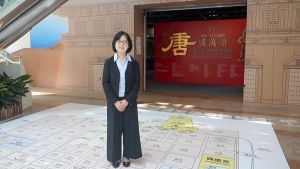
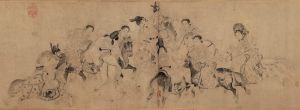
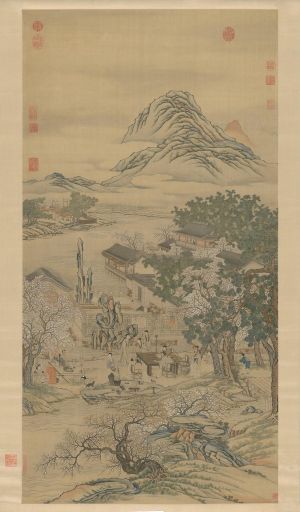
The exhibition is divided into eight sections that recreate the Tang dynasty from multiple perspectives, covering its administrative system and governance, city planning, the life of people, religious beliefs, literati elegance, craftsmanship, as well as scenes along the land-based Silk Road and the Maritime Silk Road. Mr Ringo Ng, Assistant Curator I (Education Activities), and Mr Sam Wu, Assistant Curator II (Exhibition & Publicity), present the relics on loan from the Liaoning Provincial Museum respectively, namely “Scroll depicting Emperor Minghuang playing polo” and “Li Bai’s Chun Ye Yan Tao Li Yuan Xu (Preface to the spring night banquet in the peach and plum garden) on kesi (cut silk) hanging scroll”. These two paintings are only displayed during the first two months (28 June to 27 August 2025). Upon their return to the Liaoning Provincial Museum, the relics will be kept at the collection stores for one to three years for conservation purpose. As such, the public is encouraged to seize this opportunity to view the two rare relics while they are exhibited in Hong Kong.

Diversity, inclusiveness and openness of prosperous Tang dynasty illustrated by extraordinary exhibits

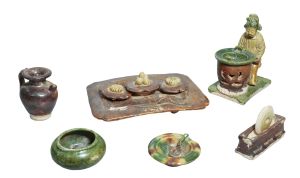
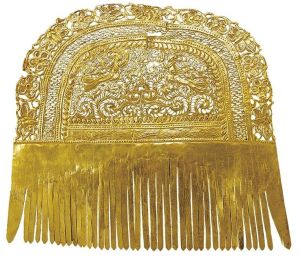
Mr Ringo Ng, Assistant Curator I (Education Activities), adds that other extraordinary exhibits, such as the Hu warrior figurine, the Hu civil official figurine, the painted figurine of character in canjun (adjutant) opera, the figurine of bare-chested Hu man and sancai polo player figurines (a set of four), all shed light on the Chinese cultural landscape characterised by integration, diversity and openness during that era. Besides, a gold jie comb (hair comb accessory) worn by Tang dynasty women, which demonstrates exquisite workmanship, and Sancai tea ware and seated figurine model (one set), the first of its kind that depicts Lu Yu, Sage of Tea, are also on display.

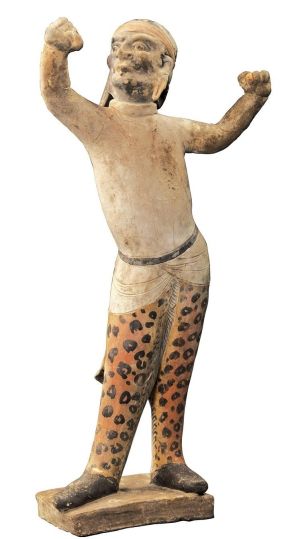
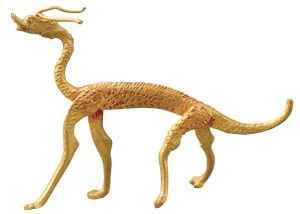
Mr Sam Wu says, while Lun Yu Zheng Xuan Zhu (the Analects with annotation by Zheng Xuan) copied by Bu Tianshou is an artefact that conveys Confucian thoughts and has been inscribed onto the first batch of the National Catalogue of Precious Ancient Books, it also emanates an innocent, child-like charm. Other significant relics include an exquisite crimson gold walking dragon used in the Taoist toulong (throwing the dragon) ceremony, an imperial object for worshipping the Buddha known as the gilt silver boluozi, a moulded and painted brick with portrait of a Hu merchant leading camel that retells the prosperity of the Maritime Silk Road, a painted figurine of dancing black man, a delicate gold ornament decorated with a standing phoenix and inlaid with turquoise, a green brocade banbi featuring phoenix in intertwining branch medallion pattern, and a Persian peacock-blue glazed ewer with two lugs that reflects the glamour of the Maritime Silk Road, and many more.

The Tang Dynasty was highly open to the outside world, encouraging Hu merchants to travel along the land-based Silk Road to do business in China. For this reason, the Silk Road was imbued with distinct cultural flavour of the Western Regions. For example, on the moulded and painted brick with portrait of a Hu merchant leading camel, the Hu merchant is depicted with deep-set eyes and a prominent nose, and dressed in Hu clothing and a Hu hat. Uncovered from the tomb of Murong Zhi, the banbi short-sleeved top is blended with Han and Hu cultures and craftsmanship. Murong Zhi’s father was the emperor of Tuyuhun, and his mother was Princess Honghua, the first Tang princess married to a foreign tribe.

Also on display: 29 pieces of Tang dynasty relics unearthed in Hong Kong

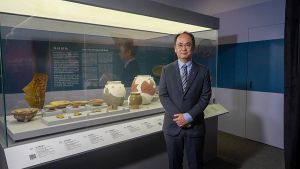
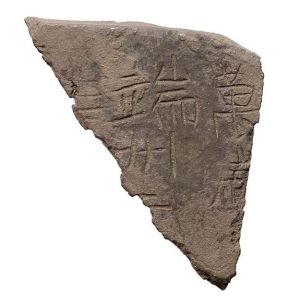
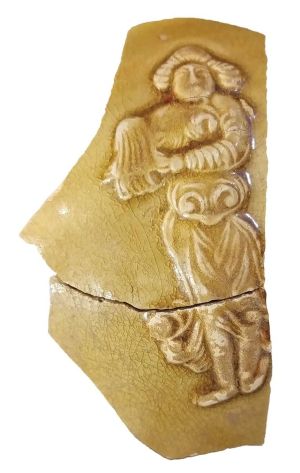
Mr Raymond Lee, Curator (Archaeology) of the AMO, shares more on the Tang relics unearthed in Hong Kong. These include “Fragment of silver piece with Chinese characters Wan Sui (longevity) and Duan Zhou”, porcelains, weapons, currencies, ornaments, and so forth. All these demonstrate that Hong Kong once played a pivotal role along the Maritime Silk Road.

You are cordially invited to visit the “Tang Vogue Beyond the Horizons: A Golden Era of Multicultural Integration and Openness” exhibition at the HDC, where you will discover the glory of the Tang dynasty’s golden age and experience first-hand the enduring brilliance of Chinese civilisation. The exhibition will run until 31 December 2025, and admission is free. You are also welcome to join the various complementing events of the exhibition.

Dedicated webpage of the “Tang Vogue Beyond the Horizons: A Golden Era of Multicultural Integration and Openness” exhibition
(https://www.amo.gov.hk/en/visitor-centre/exhibitions/heritage-discovery-centre/tang-exhibition/index.html)

Please click on the image above to watch the video.
According to Ms Susanna Siu, Chief Heritage Executive of the AMO of the DEVB, the “Tang Vogue Beyond the Horizons” exhibition is curated on the basis of “Tang China: A Cosmopolitan Dynasty (7th–10th century)”, an exhibition co-organised by the NCHA and Musée National des Arts Asiatiques-Guimet to celebrate the 60th anniversary of the establishment of China-France diplomatic relations.  It is also one of the celebratory events marking the 28th anniversary of Hong Kong’s return to the Motherland.  It is the largest joint exhibition, in terms of profile, scale and quantity of artefacts on display since the signing of the Framework Agreement on Deepening Exchange and Cooperation in the Field of Heritage Architecture and Archaeology between the DEVB and NCHA in 2022.
According to Ms Susanna Siu, Chief Heritage Executive of the AMO of the DEVB, the “Tang Vogue Beyond the Horizons” exhibition is curated on the basis of “Tang China: A Cosmopolitan Dynasty (7th–10th century)”, an exhibition co-organised by the NCHA and Musée National des Arts Asiatiques-Guimet to celebrate the 60th anniversary of the establishment of China-France diplomatic relations. It is also one of the celebratory events marking the 28th anniversary of Hong Kong’s return to the Motherland. It is the largest joint exhibition, in terms of profile, scale and quantity of artefacts on display since the signing of the Framework Agreement on Deepening Exchange and Cooperation in the Field of Heritage Architecture and Archaeology between the DEVB and NCHA in 2022.
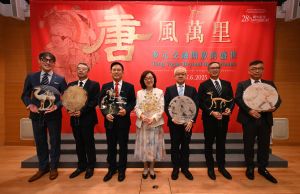
The opening ceremony of the exhibition entitled “Tang Vogue Beyond the Horizons: A Golden Era of Multicultural Integration and Openness” was held at the HDC on 27 June.  The photo shows Ms Bernadette Linn (centre), Secretary for Development; Mr Qiao Yunfei (third right), Deputy Administrator of the NCHA; Mr Wang Songmiao (third left), Secretary General of the Liaison Office of the Central People’s Government in the Hong Kong Special Administrative Region (LOCPG); Mr Ricky Lau (second right), Permanent Secretary for Development (Works); Mr Tan Ping (second left), Director of Art Exhibitions China; Professor Desmond Hui (first right), Chairman of the Antiquities Advisory Board; and Professor Douglas So (first left), Chairman of the Advisory Committee on Built Heritage Conservation, officiating at the opening ceremony.
The opening ceremony of the exhibition entitled “Tang Vogue Beyond the Horizons: A Golden Era of Multicultural Integration and Openness” was held at the HDC on 27 June. The photo shows Ms Bernadette Linn (centre), Secretary for Development; Mr Qiao Yunfei (third right), Deputy Administrator of the NCHA; Mr Wang Songmiao (third left), Secretary General of the Liaison Office of the Central People’s Government in the Hong Kong Special Administrative Region (LOCPG); Mr Ricky Lau (second right), Permanent Secretary for Development (Works); Mr Tan Ping (second left), Director of Art Exhibitions China; Professor Desmond Hui (first right), Chairman of the Antiquities Advisory Board; and Professor Douglas So (first left), Chairman of the Advisory Committee on Built Heritage Conservation, officiating at the opening ceremony.
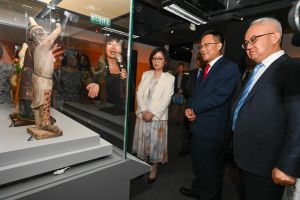
Ms Bernadette Linn (second left), Secretary for Development; Mr Qiao Yunfei (first right), Deputy Administrator of the NCHA; and Mr Wang Songmiao (second right), Secretary General of the LOCPG, are touring the exhibition.
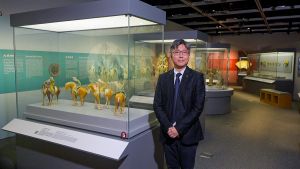
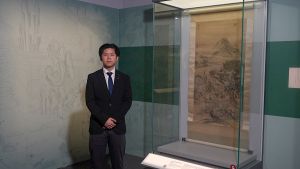
Mr Ringo Ng (pictured above), Assistant Curator I (Education Activities) of the AMO, highlights a key exhibit on loan from the Liaoning Provincial Museum, namely “Scroll depicting Emperor Minghuang playing polo”.  Mr Sam Wu (pictured below), Assistant Curator II (Exhibition & Publicity), introduces “Li Bai’s Chun Ye Yan Tao Li Yuan Xu (Preface to the spring night banquet in the peach and plum garden) on kesi (cut silk) hanging scroll”.  These two exhibits are only displayed during the first two months (28 June to 27 August 2025).  Upon their return to the Liaoning Provincial Museum, these artefacts will be kept at the collection stores for one to three years for conservation purpose.
Mr Ringo Ng (pictured above), Assistant Curator I (Education Activities) of the AMO, highlights a key exhibit on loan from the Liaoning Provincial Museum, namely “Scroll depicting Emperor Minghuang playing polo”. Mr Sam Wu (pictured below), Assistant Curator II (Exhibition & Publicity), introduces “Li Bai’s Chun Ye Yan Tao Li Yuan Xu (Preface to the spring night banquet in the peach and plum garden) on kesi (cut silk) hanging scroll”. These two exhibits are only displayed during the first two months (28 June to 27 August 2025). Upon their return to the Liaoning Provincial Museum, these artefacts will be kept at the collection stores for one to three years for conservation purpose.
The photo shows the “Scroll depicting Emperor Minghuang playing polo”, which is a depiction of 16 riders, including Emperor Xuanzong of Tang (Minghuang), his concubines and others, playing polo on horseback.
The photo shows the hanging scroll of Li Bai’s Chun Ye Yan Tao Li Yuan Xu (Preface to the spring night banquet in the peach and plum garden) on kesi (cut silk), depicting the refined life of Tang dynasty literati.
The photo shows Sancai tea ware and a seated figurine depicting Lu Yu, Sage of Tea.
The photo shows a painted figurine of a dancing black man with exotic charm.
The photo shows a crimson gold walking dragon used in ritual ceremonies.
The photo shows a gold jie comb (hair comb accessory) carved in openwork from a thin piece of gold.
Mr Raymond Lee, Curator (Archaeology) of the AMO, says that Tang relics unearthed in Hong Kong are also shown in the same exhibition.  These include “Fragment of silver piece with Chinese characters Wan Sui (longevity) and Duan Zhou”, porcelains, weapons, currencies, ornaments, and so forth, demonstrating that Hong Kong once held a pivotal role along the Maritime Silk Road.
Mr Raymond Lee, Curator (Archaeology) of the AMO, says that Tang relics unearthed in Hong Kong are also shown in the same exhibition. These include “Fragment of silver piece with Chinese characters Wan Sui (longevity) and Duan Zhou”, porcelains, weapons, currencies, ornaments, and so forth, demonstrating that Hong Kong once held a pivotal role along the Maritime Silk Road.
The photo shows a fragment of silver piece with Chinese characters Wan Sui (longevity) and Duan Zhou (present-day Zhaoqing in Guangdong province) excavated at San Tau on Lantau Island, Hong Kong.
The photo shows a fragment of glazed porcelain with a foreign figurine from Changsha Kiln excavated at Sham Wan Tsuen in Chek Lap Kok, Lantau Island, Hong Kong.
The exhibition will run until 31 December 2025, and admission is free. You are also welcome to join the various complementing events of the exhibition.

3 August, 2025

Back