Elderly-friendly Building Design to Encourage Ageing in Place

Education is the cornerstone of social progress, while the construction industry is the backbone of urban development. Combining the two not only provides students with rich learning materials but also inspires their interest in STEAM (Science, Technology, Engineering, Arts and Mathematics), aligning with the Government’s commitment to promoting STEAM education. To this end, the Development Bureau (DEVB), in collaboration with the Construction Industry Council (CIC), has launched the “STEAM UP” project with the construction and education sectors, producing Hong Kong’s first-ever set of construction-themed STEAM learning and teaching (L&T) materials for a total of 1 000 primary and secondary schools across the territory, alongside a promotional campaign on infrastructure. On this occasion, I have invited colleagues from the DEVB as well as representatives from the construction and education sectors to introduce this cross-sector collaboration.

First set of “Infrastructure × Education” L&T materials piloted by 25 primary and secondary schools, to be progressively rolled out to 1 000 schools across the territory

Mr FUNG Chun-kong, Assistant Secretary (Policy and Development) of the DEVB, says that Hong Kong’s first set of construction-themed STEAM L&T materials has been piloted by 25 primary and secondary schools so far. Teachers and students have responded positively, noting that real-life project cases can effectively spark students’ interest in learning, making teaching and learning more effective. We will progressively provide materials for a total of about 1 000 primary and secondary schools across the territory for use in the 2025/26 school year. Interested schools can also download the materials for free and get the updates via the website of the “STEAM UP” project (https://steam.constructionhk.org/langEn/resources/resources-detail?id=5a7d7037-831d-471b-b9bb-effdf2628f78).

Construction and education intertwine: A single bridge showcases all STEAM elements

The construction industry is closely intertwined with our daily lives, but how does it relate to education? Take the Tseung Kwan O Cross Bay Bridge as an example. The bridge deck was installed using the “float-over method”, which involves scientific concepts of tides and buoyancy learnt in Primary Science class, bridge-related structural mechanics and engineering principles learnt in Secondary Science class, as well as the learning content of the Chemistry and Technology subjects at the senior secondary level. Furthermore, the double-arch steel form of the bridge resembles a mathematical symbol, exhibiting artistic beauty from an aesthetic perspective. It can be seen that this single bridge project already encompasses all five elements of STEAM (Science, Technology, Engineering, Arts and Mathematics).

Eight more sets of materials to be released progressively; construction professionals to share knowledge in schools

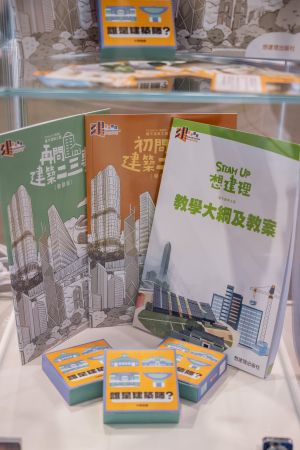
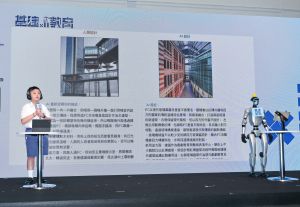
The first set of construction-themed STEAM L&T materials covers areas such as architecture, surveying, planning, landscape architecture and engineering. Ms Rebecca CHOI, Assistant Director (Qualification and Quality Control) of the Hong Kong Institute of Construction (HKIC), introduces that the materials include not only lesson plans for teachers but also storybooks, games and e-learning platforms for students, providing comprehensive support for STEAM teaching. Eight more sets of materials covering more content in different professional fields will be successively rolled out, and are expected to be available for use by primary and secondary schools across the territory in the 2025/26 school year.

Ms Rebecca CHOI adds that professionals such as engineers, architects and surveyors will also be invited under the project to share real-life project cases with students in class. For example, explaining how factors like ventilation, natural lighting and circulation are considered when designing buildings provides excellent materials for developing systematic thinking. In addition, teachers can acquire professional knowledge in construction, which facilitates mutual growth through teaching and learning and thereby further enhances teaching quality.

Besides, extended activities have also been arranged under the project, such as publishing the “Infrastructure × Education Newspaper”, which allows students to interview construction experts in different roles, including the Permanent Secretary for Development (Works), heads of works departments and the Chairman of the CIC. Apart from concrete examples from Hong Kong, the experts have shared national achievements and knowledge in various engineering fields with students, and, more importantly, inspired them to ask questions and broaden their horizons.

L&T materials piloted by 25 primary and secondary schools, with 200 more schools signed up for the trial

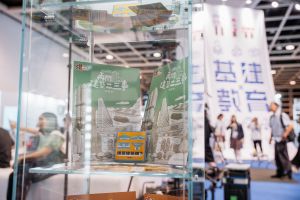
The DEVB, the CIC, the Education Bureau (EDB), works departments and industry organisations presented the “Infrastructure × Education” Exhibition at the “Learning & Teaching Expo 2025” from 2 to 4 July this year. Ms HO Wing-yin, Assistant Secretary (Works Policies) of the DEVB, says the exhibition enabled principals, teachers and students to gain in-depth understanding of the diverse facets and future development of the construction industry. The exposition attracted more than 20 000 attendance with participation of over one-third of the primary and secondary schools in the territory, and 200 primary and secondary schools signed up during the exhibition to adopt the L&T materials in the upcoming school year.

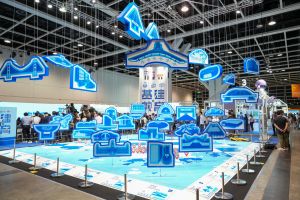
Ms Ellen WONG, Senior Manager (Industry Promotion) of the CIC, shares the three major highlights of the “Infrastructure × Education” Exhibition, including the first collaboration among the Government, the construction industry and the education sector to produce STEAM L&M materials, which were promoted during the exhibition; the display of Hong Kong’s first 3-dimensional (3D) infrastructure map to introduce its achievements and innovation in infrastructure to the public; and the application of the scientific principles and technological knowledge involved in STEAM learning in everyday infrastructure projects to inspire students’ thinking.

Furthermore, a construction career zone was set up in the exhibition, emphasising the technological elements of the industry. It featured an artificial intelligence (AI) game modelled on the first set of architecture-themed L&T materials. CHUNG Ho-him, a student from Methodist School, participated in a demonstration, competing with an “AI Architect” to design new landmarks for Hong Kong.

A win-win for the industry and students: Stories behind projects enhance interest in learning

At the exhibition’s launching ceremony, Mr Jeff SZE, Under Secretary for Education, expressed his gratitude to the industry for its full support for the “STEAM UP” project. He remarked that the L&T materials incorporate real-life infrastructure examples in the engineering sector, and schools have reflected that the materials are incredibly helpful for teaching.

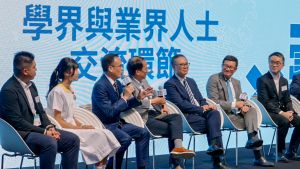
Mr KAN Wai-hung, Principal of the Hong Kong Taoist Association (HKTA) The Yuen Yuen Institute No. 1 Secondary School, described the materials as “comprehensive, professional and down-to-earth.” He noted that the package provides numerous lesson plans to assist teachers in lesson preparation, teaching and even assessment, and contains many concrete examples that help students learn STEAM in a “down-to-earth” manner, greatly enhancing their interest in learning and understanding of the content.

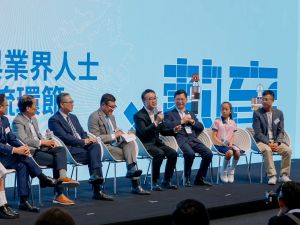
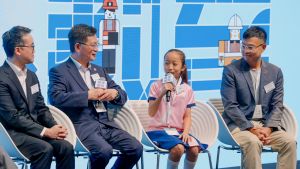
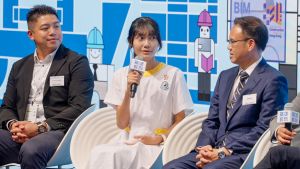
Student LAI Hei-nam from Ma On Shan Methodist Primary School shared that through the project, she learnt that building a bridge requires highly precise calculation, which has inspired her with determination to study mathematics more diligently in the future. Meanwhile, student LAU Kai-yi from HKTA The Yuen Yuen Institute No. 1 Secondary School, who had interviewed the Director of Civil Engineering and Development, shared that she was deeply impressed by the rotation construction method, which made possible the connection of the Fanling Bypass viaduct overnight. She found the innovative building method truly eye-opening.

Collaborative efforts to drive lasting positive impact through “Construction × Education”

The DEVB will continue to work closely with the EDB, the CIC, and the construction and education sectors to expand the “STEAM UP” project. We will organise more industry experiential activities, provide career planning services for students through the newly opened STEAM learning resource centre, and continue to stage “Infrastructure × Education” roving exhibitions in various districts. Let’s work together to tell the good stories of Hong Kong through our infrastructure and build dreams for the future through education!

Please click the image above to watch the video.
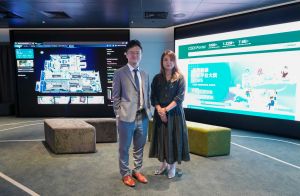
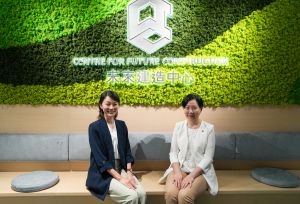
Mr FUNG Chun-kong, Assistant Secretary (Policy and Development) of the DEVB (left), and Ms Rebecca CHOI, Assistant Director (Qualification and Quality Control) of the HKIC, introduce the first set of construction-themed STEAM L&T materials, which have been piloted by 25 primary and secondary schools so far.  The DEVB and the CIC will progressively provide the materials for a total of approximately 1 000 primary and secondary schools across the territory for use in the 2025/26 school year.
Mr FUNG Chun-kong, Assistant Secretary (Policy and Development) of the DEVB (left), and Ms Rebecca CHOI, Assistant Director (Qualification and Quality Control) of the HKIC, introduce the first set of construction-themed STEAM L&T materials, which have been piloted by 25 primary and secondary schools so far. The DEVB and the CIC will progressively provide the materials for a total of approximately 1 000 primary and secondary schools across the territory for use in the 2025/26 school year.
The L&T materials cover areas such as architecture, surveying, planning, landscape architecture and engineering, featuring storybooks, games and e-learning platforms tailored for students to provide comprehensive support for STEAM teaching in schools.  Eight more sets of materials covering more content in different professional fields will be rolled out progressively, and are expected to be available for use by all primary and secondary schools in Hong Kong in the 2025/26 school year.
The L&T materials cover areas such as architecture, surveying, planning, landscape architecture and engineering, featuring storybooks, games and e-learning platforms tailored for students to provide comprehensive support for STEAM teaching in schools. Eight more sets of materials covering more content in different professional fields will be rolled out progressively, and are expected to be available for use by all primary and secondary schools in Hong Kong in the 2025/26 school year.
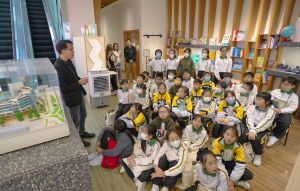
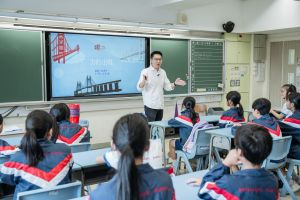
Professionals such as engineers, architects and surveyors will also be invited under the project to share real-life project cases with students in class.  The photo shows an architect introducing infrastructure to students.
Professionals such as engineers, architects and surveyors will also be invited under the project to share real-life project cases with students in class. The photo shows an architect introducing infrastructure to students.
A teacher cites real-life examples provided in the L&T materials to teach students mechanics.
Ms HO Wing-yin, Assistant Secretary (Works Policies) of the DEVB (left), and Ms Ellen WONG, Senior Manager (Industry Promotion) of the CIC (right), introduce the “Infrastructure × Education” Exhibition jointly organised by the DEVB, the CIC, the EDB, works departments and industry organisations at the “Learning & Teaching Expo 2025” from 2 to 4 July this year.
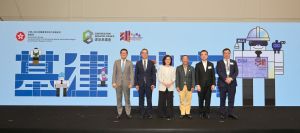
Ms Bernadette LINN, Secretary for Development (third left); Mr Ricky LAU, Permanent Secretary for Development (Works) (second left); Mr Jeff SZE, Under Secretary for Education (second right); Professor Thomas HO, Chairman of the CIC (third right); Mr Albert CHENG, Executive Director of the CIC (first left); and Dr Tenny LAM, Executive Director of Hong Kong Education City (first right), take a photo together at the launching ceremony of the “Infrastructure × Education” Exhibition and the first phase of achievement of the “STEAM UP” project.
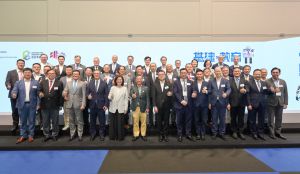
Ms Bernadette LINN, Secretary for Development (fifth left, front row), takes a group photo with officiating guests, Legislative Council Members, heads of works departments and other guests.
Student CHUNG Ho-him from Methodist School (left) competes with an “AI Architect” in an architectural design contest, demonstrating an AI game modelled on the first set of architecture-themed L&T materials.
The “Infrastructure × Education” Exhibition features Hong Kong’s first 3D infrastructure map to introduce its achievements and innovation in infrastructure to the public.
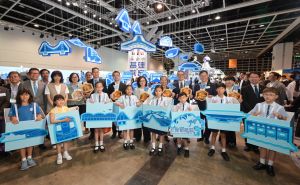
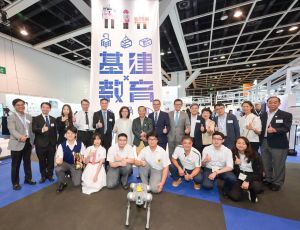
Ms Bernadette LINN, Secretary for Development (sixth right, back row); Mr Ricky LAU, Permanent Secretary for Development (Works) (fourth right, back row); Mr Jeff SZE, Under Secretary for Education (seventh right, back row); Professor Thomas HO, Chairman of the CIC (fifth right, back row); and Mr Albert CHENG, Executive Director of the CIC (second left, back row), take a group photo with other guests and students in front of Hong Kong’s first 3D infrastructure map.
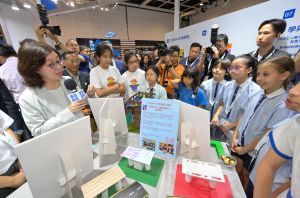
Ms Bernadette LINN, Secretary for Development (first left), interacts with students from participating schools to learn more about their creations.
Mr Jeff SZE, Under Secretary for Education (centre), expresses his gratitude to the industry for its full support for the “STEAM UP” project.  He remarks that the materials incorporate specific projects in the engineering sector as examples, and schools have reflected that the “STEAM UP” L&T materials are incredibly helpful for teaching.
Mr Jeff SZE, Under Secretary for Education (centre), expresses his gratitude to the industry for its full support for the “STEAM UP” project. He remarks that the materials incorporate specific projects in the engineering sector as examples, and schools have reflected that the “STEAM UP” L&T materials are incredibly helpful for teaching.
Mr KAN Wai-hung, Principal of HKTA The Yuen Yuen Institute No. 1 Secondary School (third left), describes the materials as “comprehensive, professional and down-to-earth,” noting that the package provides numerous lesson plans to assist teachers in lesson preparation, teaching and even assessment.
Student LAI Hei-nam from Ma On Shan Methodist Primary School (second right) shares that through the project, she learns that building bridges requires highly precise calculation, which has inspired her with determination to study mathematics more diligently in the future.
Student LAU Kai-yi from HKTA The Yuen Yuen Institute No. 1 Secondary School (centre) is delighted to participate in the project.  She is deeply impressed by the rotation construction method, which made possible the connection of the Fanling Bypass viaduct overnight, and finds the innovative building method truly eye-opening.
Student LAU Kai-yi from HKTA The Yuen Yuen Institute No. 1 Secondary School (centre) is delighted to participate in the project. She is deeply impressed by the rotation construction method, which made possible the connection of the Fanling Bypass viaduct overnight, and finds the innovative building method truly eye-opening.
Ms Bernadette LINN, Secretary for Development (sixth left, back row); Mr Ricky LAU, Permanent Secretary for Development (Works) (seventh right, back row); Professor Thomas HO, Chairman of the CIC (seventh left, back row); and Mr Albert CHENG, Executive Director of the CIC (sixth right, back row), take a group photo with other guests and students.

20 July, 2025

Back