Revitalisation of Tsui Ping River: Enhancing flood resilience and implementing the “Rivers in the City” concept

In recent years, while striving to enhance the flood resilience of drainage facilities, the Drainage Services Department (DSD) has also been adhering to the concept that “lucid waters and lush mountains are invaluable assets” and actively putting the concept of “Rivers in the City” into practice, with a view to creating a better living environment for the public by breathing new life into our rivers through enhancing river ecosystems and landscape design. The revitalised Tsui Ping River is a prime example, and I attended its opening ceremony earlier. On this occasion, I have invited colleagues from the DSD to shed light on the concepts and challenges behind the revitalisation project, while a Kwun Tong District Council (DC) Member and nearby residents will also share their views on the new facilities.

Tsui Ping River open to public after transformation of old nullah

Mr Antony WAN Nam-fung, Senior Engineer (Drainage Projects Division) of the DSD, explains that Tsui Ping River was originally an open nullah. Before that, it was a winding stream flowing through Ma Yau Tong into Victoria Harbour, with its catchment covering Kwun Tong Town Centre, Sau Mau Ping and Lam Tin. In the 1950s, the watercourse was artificially modified into an open nullah.

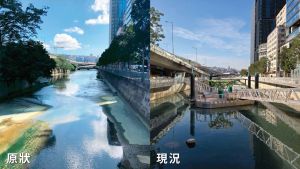
The nullah was an early-built flood discharge channel, with its riverbed and riverbanks covered with concrete to enhance flood conveyance capacity. Situated next to Kwun Tong Business Area and residential areas, the nullah ran from Kai Lim Road along Tsui Ping Road, King Yip Lane and King Yip Street all the way to Victoria Harbour, with a total length of approximately one kilometre. In the past, the long-term discharge of pollutants from industrial buildings in the area led to a deterioration in water quality and a persistent odour in the vicinity.

In view of this, the Development Bureau (DEVB) proposed in 2012 the transformation of the early-built, flood control-oriented nullah into “Tsui Ping River” under the “Rivers in the City” concept, without compromising its stormwater drainage function and capacity. In 2020, the DSD launched the “Revitalisation of Tsui Ping River” project to transform the nullah into a beautiful riverside space by enhancing its flood resilience and implementing environmental, ecological and landscape improvement works. The revitalised Tsui Ping River has recently been officially open for public enjoyment.

Tsui Ping River facilities well received by the public

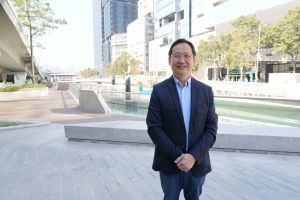
Mr Wilson OR Chong-shing, Kwun Tong DC Member, considers that the revitalised Tsui Ping River meets public expectation as the facilities serve the purposes of flood discharge, conservation and leisure use. He says that since its opening, members of the public have expressed great appreciation for the river’s new look, which is a testament to its success. Mr OR also hopes that the DSD can extend the nullah revitalisation scheme to other districts, so that more members of the public can enjoy beautiful riverside spaces.

Enhancing flood resilience to cope with extreme weather

Mr Antony WAN indicates that the project team faced many challenges during the revitalisation process. Enhancing flood resilience is one of the key objectives of the project. Amidst the densely-built urban environment of Kwun Tong, the DSD carried out a series of improvement works, including removal of the original drainage bottleneck and strengthening of Tsui Ping River’s resilience against rainstorms, so as to meet the prevailing flood protection design standards.

The base of the original footbridge across Tsui Ping Road once straddled the nullah, restricting the flow depth to no more than 1.8 metres and creating a bottleneck in flood discharge. The project team prioritised the reconstruction of the footbridge while ensuring that there would be no disruption to its operation during the works period. After the reconstruction was completed, the footbridge base was removed to eliminate the obstruction to flood discharge. In addition, the team deepened the channel along the section from Tsui Ping Road to King Yip Street and installed a 1.2-metre-high flood wall upstream. These works have boosted the maximum flood discharge capacity of Tsui Ping River to over 150 cubic metres per second, equivalent to filling an Olympic-sized swimming pool within about 17 seconds.

As Tsui Ping River is a flood discharge channel in operation, its water level can rise rapidly within a short period during heavy rainstorms, posing challenges to project operation and works progress. To address this issue, the project team has applied artificial intelligence technology to analyse rainfall forecast data to predict changes in the river’s water level within a two-hour window. When the water level is projected to exceed the safety threshold, a notification will be issued immediately to the personnel concerned, allowing sufficient time for frontline staff to take follow-up actions to ensure site safety. Furthermore, at the design stage of the project, the team collected water samples from various rainwater catchment areas along the river for analysis. Dry weather flow interceptors were subsequently installed at Shui Wo Street, King Yip Street and Wai Fat Road to intercept polluted dry weather flows within the stormwater drains and divert them to the sewerage system for treatment, thereby reducing pollution loads discharged into the rainwater harvesting system. Since the commencement of the project, there has been a marked improvement in the river’s water quality.

Smart water gate in place to improve the river’s water quality

The original nullah was criticised for its unpleasant odour. To improve the water quality of Tsui Ping River, the project team has installed a smart water gate that rises and falls in sync with the tides downstream near Hung To Road. The gate regulates water levels to maintain adequate water in the river, reducing the chance of its drying up and thus mitigating the odour problem. Mr Antony WAN explains that during high tides, the water gate lowers itself until it lies flat on the riverbed, allowing seawater to flow into Tsui Ping River; after high tides, the gate rises to retain the seawater, forming a water storage area. The gate then slowly lowers itself again to release the stored water downstream, creating a small waterfall effect to stabilise the water body of Tsui Ping River. When the upstream water level exceeds the preset level, or when the Hong Kong Observatory issues an inclement weather warning signal, the water gate will lower itself to lie flat on the riverbed to ensure that the river maintains the full flood-carrying capacity.

Despite the above measures taken, the water quality of Tsui Ping River may still be affected by the upstream catchment area, with mild odour problems arising from seasonal changes, weather conditions and local activities. The DSD will continue to monitor the situation closely and take follow-up measures as necessary.

Enhancing the ecological environment and creating a vibrant riverside open space

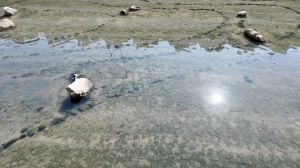
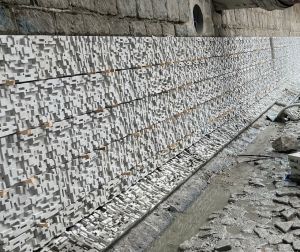
In addition, to facilitate pedestrian movement between the riverbanks, the team has constructed six cross-river walkways and a pontoon along the river to shorten the walking distance between the riverbanks, with a view to connecting Kwun Tong’s industrial, commercial and residential areas with the Kwun Tong and Cha Kwo Ling waterfront areas. To beautify the riverscape, the DSD has installed distinctive funnel-shaped planters and seating on the pontoon, which rises and falls with the water level, offering the public a unique water-friendly experience. Plants and ecological devices have also been provided along the river to create a favourable ecological environment. Among the devices, bird perching poles provide resting and foraging spots for birds; rock pools serve as habitats where fish can live and breed; and eco-walls attract various creatures by providing shelter and foraging grounds, which in turn draws more species to the site.

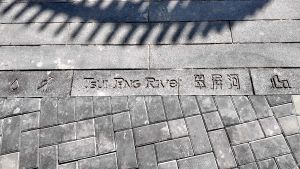
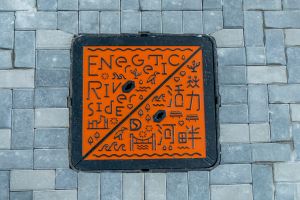
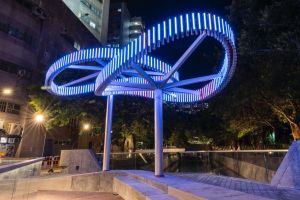
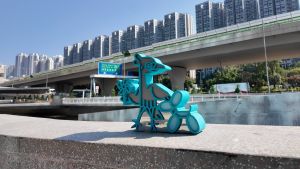
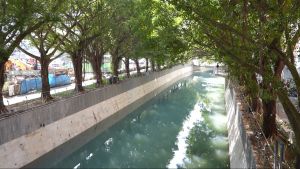
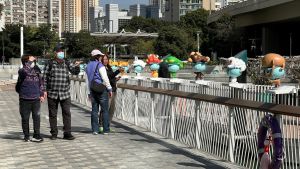
The team has also built six landscaped decks with community-innovation concept along the river, featuring gateway landmarks, distinctive manhole covers, the artistic lighting installation named “Wander Rings”, and art installations of Tsui Ping River’s mascot “Tsui Ping Bird”, to provide a creative riverside open space in the densely-built urban area of Kwun Tong. Along the riverbanks near King Yip Lane, more than 50 Chinese banyan trees have been preserved to create a green corridor in Kwun Tong Town Centre, adding a touch of nature to Tsui Ping River.

A beautifully revitalised environment with much reduced odour: A change welcomed by residents

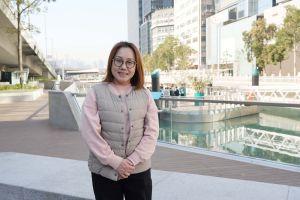
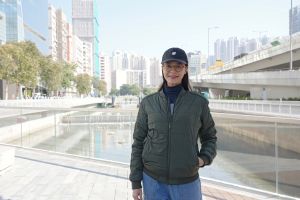
Ms KWOK, who has been working in Kwun Tong for nearly two decades, has witnessed the transformation of Tsui Ping River. She recalls that the old nullah used to give off an unpleasant odour that left a strong impression on her, but the smell in the vicinity of the revitalised Tsui Ping River has now improved significantly.

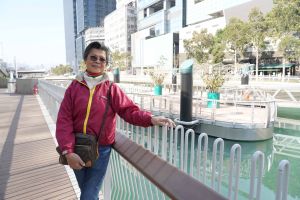
Ms LAM, a long-time resident of Kwun Tong, recalls the messy environment of the former Kwun Tong Resettlement Estate and the foul smell of the nearby “big nullah”. She is pleasantly surprised by the tremendous changes brought about by the revitalisation. She now strolls along the river regularly, appreciating the beautiful riverside scenery, and is particularly delighted to see egrets roosting in the river, which comes as a wonderful surprise to her.

Ms CHEUNG, who also works in Kwun Tong, notes that there have been significant changes in both sight and smell after the revitalisation of Tsui Ping River. In the past, only blue-collar workers from the nearby factory area would take a rest near the nullah, but now many more office workers and local residents unwind and stroll along Tsui Ping River. She sees the revitalisation project as a good start with a constructive impact, and looks forward to seeing more greening spaces along the river in the future.

The revitalised Tsui Ping Riverside Promenade is now fully open. It is hoped that the promenade will become a new landmark of Kwun Tong. Come to visit and enjoy this vibrant public space!

Please click the image above to watch the video.
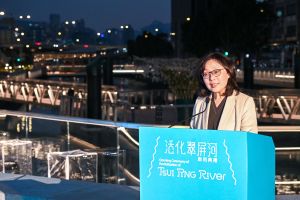
Ms Bernadette LINN Hon-ho, Secretary for Development, says that in recent years, while striving to enhance the flood resilience of drainage facilities, the DSD has also been adhering to the concept that “lucid waters and lush mountains are invaluable assets” and actively putting the concept of “Rivers in the City” into practice, with a view to creating a better living environment for the public by breathing new life into our rivers through enhancing   river ecosystems and landscape design.  Tsui Ping River is a prime example.
Ms Bernadette LINN Hon-ho, Secretary for Development, says that in recent years, while striving to enhance the flood resilience of drainage facilities, the DSD has also been adhering to the concept that “lucid waters and lush mountains are invaluable assets” and actively putting the concept of “Rivers in the City” into practice, with a view to creating a better living environment for the public by breathing new life into our rivers through enhancing river ecosystems and landscape design. Tsui Ping River is a prime example.
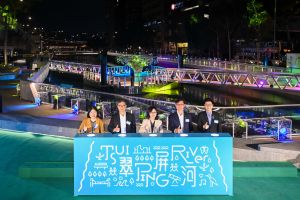
The river facilities along the section near King Yip Street under the DSD’s “Revitalisation of Tsui Ping River” project were open for public enjoyment on 12 December 2024. Picture shows Ms Bernadette LINN, Secretary for Development (centre); Mr Ricky LAU Chun-kit, Permanent Secretary for Development (Works) (second left); Mr Ringo MOK Wing-cheong, Director of Drainage Services (second right); Ms April KUN Ka-yin, Head of Energizing Kowloon East Office (first left); and Mr Denny HO Lap-ki, District Officer (Kwun Tong) (first right), officiating at the lighting ceremony during the opening event.
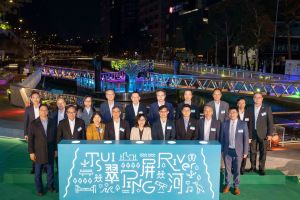
Ms Bernadette LINN, Secretary for Development (centre, front row); Ir Dr Hon LO Wai-kwok, Legislative Council (LegCo) Member (Engineering), (second left, front row); Hon Perry YIU Pak-leung, LegCo Member (Tourism) (second right, front row); Hon Bill TANG Ka-piu, LegCo Member (Kowloon East) ( first left, front row); Hon Frankie NGAN Man-yu, LegCo Member (Kowloon East) (first right, front row) and other guests take a photo together at the opening ceremony.
Mr Antony WAN, Senior Engineer (Drainage Projects Division) of the DSD, explains that the DEVB proposed in 2012 the transformation of the early-built, flood control-oriented nullah into “Tsui Ping River” under the “Rivers in the City” concept, without compromising its stormwater drainage function and capacity.
In the 1950s, the watercourse was artificially modified into an open nullah.
The nullah narrows at King Yip Lane, forming a bottleneck that can easily lead to flooding during rainstorms.
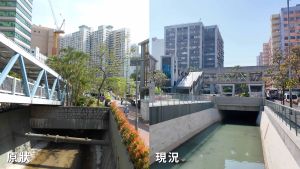
In the past, the long-term discharge of pollutants from industrial buildings led to a deterioration in water quality and a persistent odour in the vicinity of the nullah. Under the “Revitalisation of Tsui Ping River” project, the nullah has been transformed into a beautiful riverside space through enhancing its flood resilience and implementing environmental, ecological and landscape improvement works.
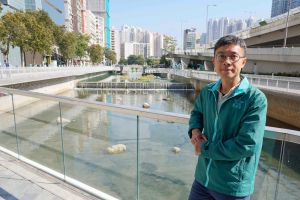
Mr Wilson OR, Kwun Tong DC Member, considers that the revitalised Tsui Ping River meets public expectation as the facilities serve the purposes of flood discharge, conservation and leisure use.
Enhancing flood resilience is a key objective of the “Revitalisation of Tsui Ping River” project.  The project team prioritised the reconstruction of the Tsui Ping Road footbridge and subsequently removed the base of the old footbridge, thereby eliminating the obstruction to flood discharge.
Enhancing flood resilience is a key objective of the “Revitalisation of Tsui Ping River” project. The project team prioritised the reconstruction of the Tsui Ping Road footbridge and subsequently removed the base of the old footbridge, thereby eliminating the obstruction to flood discharge.
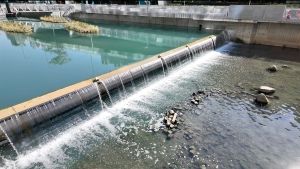
A smart water gate that rises and falls in sync with the tides is installed at the downstream of Tsui Ping River near Hung To Road.  It regulates water levels to maintain adequate water in the river, reducing the chance of its drying up and thus mitigating the odour problem. The gate will also form a water storage area, creating a small waterfall effect and ensuring the river’s flood-carrying capacity.
A smart water gate that rises and falls in sync with the tides is installed at the downstream of Tsui Ping River near Hung To Road. It regulates water levels to maintain adequate water in the river, reducing the chance of its drying up and thus mitigating the odour problem. The gate will also form a water storage area, creating a small waterfall effect and ensuring the river’s flood-carrying capacity.
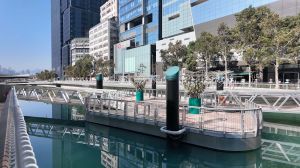
The project team has constructed six cross-river walkways and a pontoon along the river to shorten the walking distance for public travelling between the riverbanks.
Plants and ecological devices are provided along Tsui Ping River to create favourable conditions for the river ecosystem and attract more species to the site.  Pictures show bird perching poles, rock pools and eco-walls.
Plants and ecological devices are provided along Tsui Ping River to create favourable conditions for the river ecosystem and attract more species to the site. Pictures show bird perching poles, rock pools and eco-walls.
Landscaped decks incorporated with placemaking and community-innovation concepts have been built along Tsui Ping River.  Pictures show a gateway landmark, a distinctive manhole cover, the artistic lighting installation named “Wander Rings”, and an art installation of Tsui Ping River’s mascot “Tsui Ping Bird”.
Landscaped decks incorporated with placemaking and community-innovation concepts have been built along Tsui Ping River. Pictures show a gateway landmark, a distinctive manhole cover, the artistic lighting installation named “Wander Rings”, and an art installation of Tsui Ping River’s mascot “Tsui Ping Bird”.
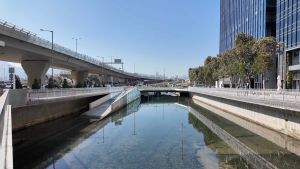
More than 50 Chinese banyan trees have been preserved along the riverbanks near King Yip Lane, creating a green corridor in Kwun Tong Town Centre.
Ms KWOK, who has been working in Kwun Tong for nearly two decades, has witnessed the transformation of Tsui Ping River.  She notes that the old nullah used to give off an unpleasant odour that left a strong impression on her, but the smell in the vicinity of the revitalised Tsui Ping River has now improved significantly.
Ms KWOK, who has been working in Kwun Tong for nearly two decades, has witnessed the transformation of Tsui Ping River. She notes that the old nullah used to give off an unpleasant odour that left a strong impression on her, but the smell in the vicinity of the revitalised Tsui Ping River has now improved significantly.
Ms LAM, a Kwun Tong resident, recalls the messy environment of the former Kwun Tong Resettlement Estate and the foul smell of the nearby “big nullah”.  The riverside space has changed a great deal following the revitalisation, which comes as a pleasant surprise to her.
Ms LAM, a Kwun Tong resident, recalls the messy environment of the former Kwun Tong Resettlement Estate and the foul smell of the nearby “big nullah”. The riverside space has changed a great deal following the revitalisation, which comes as a pleasant surprise to her.
Ms CHEUNG, who works in Kwun Tong, notes that there have been significant changes in both sight and smell after the revitalisation of Tsui Ping River.  She considers that the revitalisation project has made a constructive impact and looks forward to seeing more greening spaces along the river in the future.
Ms CHEUNG, who works in Kwun Tong, notes that there have been significant changes in both sight and smell after the revitalisation of Tsui Ping River. She considers that the revitalisation project has made a constructive impact and looks forward to seeing more greening spaces along the river in the future.
The revitalised Tsui Ping Riverside Promenade is now fully open.  It is hoped that the promenade will become a new landmark of Kwun Tong and a vibrant public space.
The revitalised Tsui Ping Riverside Promenade is now fully open. It is hoped that the promenade will become a new landmark of Kwun Tong and a vibrant public space.

19 January, 2025

Back