“Nanhai I” unravels the mystery of the Maritime Silk Road

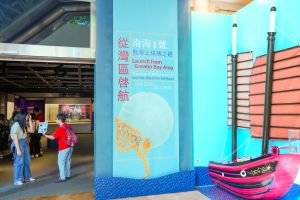
Unearthed relics and archaeological sites appear to be silent, but they carry clues that transcend time and space and tell stories left behind by the history. The “Launch from Greater Bay Area: Nanhai I Shipwreck and the Maritime Silk Road” exhibition, jointly organised by the Development Bureau, the National Cultural Heritage Administration, and the Secretariat for Social Affairs and Culture of the Government of the Macao Special Administrative Region, is being held at the Hong Kong Heritage Discovery Centre (HDC) in Tsim Sha Tsui. It depicts prosperous scenes along the Maritime Silk Road in the Song dynasty while also highlighting the roles played by Guangdong, Hong Kong and Macao on the Maritime Silk Road. For this occasion, I have invited colleagues from the Antiquities and Monuments Office (AMO) to give you an introduction of the exhibition.

“Nanhai I”: The most intact and largest ancient ocean-going merchant vessel ever discovered in archaeological excavations worldwide to date

According to Ms Susanna Siu, Chief Heritage Executive of the AMO, a Chinese merchant vessel from the Song dynasty had lain silently on the seabed at a depth of over 20 metres at the junction of Taishan and Yangjiang in Guangdong Province for over 800 years before it was discovered in 1987. In 2007, archaeologists salvaged the shipwreck in its entirety. The vessel is now housed in the Maritime Silk Road Museum of Guangdong, Yangjiang. After the shipwreck was salvaged and excavated, archaeologists meticulously observed and studied the cargoes on board, using clues from the relics to further unravel the mystery surrounding “Nanhai I”, including the departure time, route, destinations and last port of call.

Ms Susanna Siu notes that “Nanhai I” is the most complete and largest ancient ocean-going merchant vessel discovered through archaeological excavation across the globe to date. The vessel carried large quantities of export porcelain, handicrafts and everyday essentials, along with abundant gold, silver and copper coins. There were also plenty of brown glazed pottery jars with inscriptions and patterns on their shoulders, generally referred to as “Kwangtung Jars” by scholars. Who would have thought that these unremarkable “Kwangtung Jars”, used for storing objects and wine, would shed new light on studying the route of “Nanhai I” and its last port of call!

Brown glazed pottery jars reveal Hong Kong as a transit hub along the trade routes in the Song dynasty

Researchers compared the brown glazed pottery jars discovered from “Nanhai I” with the “Kwangtung Jars” excavated from the Song dynasty cultural layer at the site of the Palace of Nanyue Kingdom in Guangzhou and found striking similarities. Ms Susanna Siu points out that the palace site housed the office of the Subprefectural Magistrate of Guangzhou in the Song dynasty. The ruins of the official wine cellar inside the palace yielded numerous of wine-related brown glazed jars with stamped inscriptions. The shapes, glaze colours and inscriptions of these jars bear a strong resemblance to those on some of the brown glazed jars discovered from “Nanhai I”. A further comparison was made with brown glazed jars of the same kind unearthed from several kilns in Nanhai, Foshan. After thorough research, it was confirmed that the brown glazed jars were all produced by the Nanhai kilns. This provides grounds for the inference that Guangzhou was the last port of call of “Nanhai I”. Fragments of similar brown glazed “Kwangtung Jars” have been unearthed at various sites in Hong Kong, with the Sacred Hill site in Sung Wong Toi, Kowloon City, yielding the most, suggesting that Hong Kong had been a transit hub along the trade routes since the Song dynasty and played a significant role in foreign trade along the Maritime Silk Road.

The massive number of unearthed relics marks the highest yield of any single underwater archaeological project in China

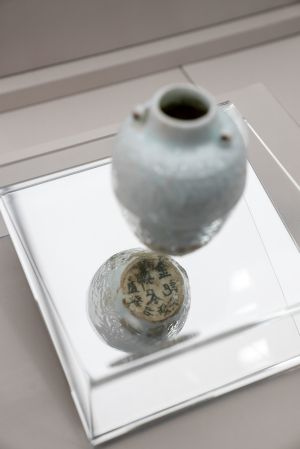
A large collection of artefacts have been discovered from “Nanhai I”, totalling nearly 180 000 pieces (sets), including about 160 000 pieces (sets) of porcelain and 124 tonnes of iron concretions, marking the highest yield of any single underwater archaeological project in China. Among the 160 000 pieces of porcelain, a Qingbai glazed jar with two lugs from the Dehua kiln in Fujian bears an ink inscription “Zheng Jin Jin Zhi Gui Mao Sui Ci” (Zheng Jinjin’s record in the Year of Guimao) at its bottom. Based on their investigations, researchers believe that “Zheng Jinjin” was a porcelain trader from Sanban Village in Dehua, Fujian, during the Southern Song dynasty; and “Guimao Suici” was an important clue for deducing the last departure time of the cargo vessel.

The year of Guimao occurred twice during the Southern Song dynasty, with the first falling in the tenth year of the Chunxi reign, namely 1183, and the second in the third year of the Chunyou reign, namely 1243. Based on discovery that the latest reign-title copper coin found on the ship is “Chunxi Yuanbao” from the Chunxi reign of Emperor Xiaozong of the Southern Song dynasty (1174 – 1189), combined with the crucial find of a brown glazed jar with stamped Chinese characters “Chun Xi Shi Nian” (the tenth year of the Chunxi reign) on board, it can be reasonably concluded that “Nanhai I” sank in 1183 or shortly thereafter.

Abundant artefacts on board help reconstruct the voyage of “Nanhai I”

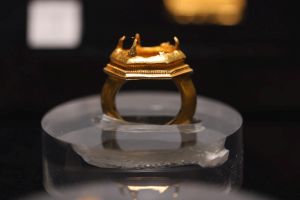
The artefacts from “Nanhai I” contain an immense wealth of information in terms of quantity, craftsmanship and form, making them rare among the archaeological findings from the Southern Song dynasty. The gold and silver coins, inlaid gold jewellery and bronze mirrors are believed to have been produced in the capital Lin’an (present-day Hangzhou) and Huzhou. The goldware was not in the mainstream styles of the Northern or Southern Song dynasties, but instead featured designs that were popular overseas. The pieces were presumably semi-finished products. For example, the bezel of the gold rings features empty settings for gemstones, possibly to be finished after being transported to overseas gem-producing areas or distribution centres. Most of the porcelain produced by the Jingdezhen kiln in Jiangxi and the Longquan kiln in Zhejiang was distributed and sold through Lin’an, Mingzhou (present-day Ningbo), Wenzhou and other places. Based on the origin of the cargoes on “Nanhai I”, researchers were able to reconstruct its voyage: the cargo ship sailed along the long coastline from north to south, traversing the Zhejiang and Fujian areas, and finally departed from the port of Guangzhou into open sea.

The exhibition runs until February 2025 with free admission

The “Launch from Greater Bay Area: Nanhai I Shipwreck and the Maritime Silk Road” exhibition, showcasing 255 exhibits, is being held until 12 February 2025. Admission is free. We have also taken advantage of the opportunity to invite experts and scholars to hold four thematic talks on “Nanhai I” from November this year [2024] to January next year [2025]. Speakers include Mr Cui Yong, China’s first-generation underwater archaeologist and the leader of the “Nanhai I” excavation mission; Mr Qu Wei, Curator of the Changsha Tongguan Kiln Museum; Mr Wei Jun, former Curator of the Guangdong Museum, incumbent research fellow and Ph.D. supervisor at Fudan University; and Professor Qin Dashu of the School of Archaeology and Museology of Peking University.

I sincerely invite you to visit this informative exhibition at the HDC in Kowloon Park, Tsim Sha Tsui. While admiring the artefacts found on the vessel, you can silently listen to the story guarded by “Nanhai I” for over 800 years. For details of the exhibition and opening hours, please refer to the following website: https://www.amo.gov.hk/en/news/index_id_153.html.

Please click the image above to watch the video.
Ms Susanna Siu, Chief Heritage Executive of the AMO, says the “Launch from Greater Bay Area: Nanhai I Shipwreck and the Maritime Silk Road” exhibition showcases prosperous scenes along the Maritime Silk Road in the Song dynasty while highlighting the roles played by the Guangdong-Hong Kong-Macao Greater Bay Area through related artefacts unearthed from the “Nanhai I” shipwreck and in Guangzhou, Hong Kong and Macao.
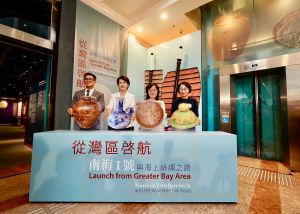
The opening ceremony of the “Launch from Greater Bay Area: Nanhai I Shipwreck and the Maritime Silk Road” exhibition was held on 15 August 2024.  Ms Bernadette Linn, Secretary for Development (second right), Ms Zhou Yu, Deputy Director of Art Exhibitions China (second left), Ms Cao Jin, President of the Guangdong Provincial Institute of Cultural Relics and Archaeology (first right), and Mr Cheang Kai-meng, Vice President of the Cultural Affairs Bureau of the Government of the Macao Special Administrative Region (first left), officiated at the opening ceremony and toured the exhibition afterwards.
The opening ceremony of the “Launch from Greater Bay Area: Nanhai I Shipwreck and the Maritime Silk Road” exhibition was held on 15 August 2024. Ms Bernadette Linn, Secretary for Development (second right), Ms Zhou Yu, Deputy Director of Art Exhibitions China (second left), Ms Cao Jin, President of the Guangdong Provincial Institute of Cultural Relics and Archaeology (first right), and Mr Cheang Kai-meng, Vice President of the Cultural Affairs Bureau of the Government of the Macao Special Administrative Region (first left), officiated at the opening ceremony and toured the exhibition afterwards.
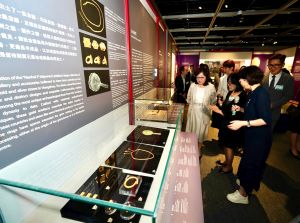
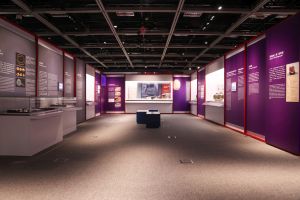
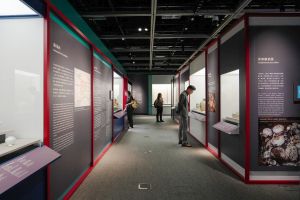
The exhibition showcases a total of 255 exhibits in three sections, namely “Nanhai I” and “Kwangtung Jars”, Restudying the route of “Nanhai I”, and “Kwangtung Jars” and the Maritime Silk Road.
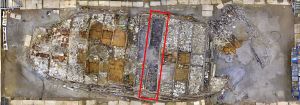
“Nanhai I” has 15 surviving cargo holds, with goods neatly stacked inside.  The red box marks the lower sections of cargo holds No. 9 and 10, where a large number of brown glazed pottery jars with inscriptions and decorations on their shoulders were unearthed, helping solve the mystery about the last port of call of “Nanhai I” before it set sail. (Photo courtesy of the Guangdong Institute of Cultural Relics and Archaeology)
“Nanhai I” has 15 surviving cargo holds, with goods neatly stacked inside. The red box marks the lower sections of cargo holds No. 9 and 10, where a large number of brown glazed pottery jars with inscriptions and decorations on their shoulders were unearthed, helping solve the mystery about the last port of call of “Nanhai I” before it set sail. (Photo courtesy of the Guangdong Institute of Cultural Relics and Archaeology)
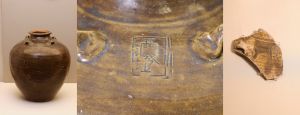
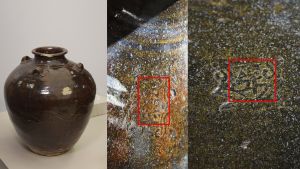
“Nanhai I” carried brown glazed jars, known as “Kwangtung Jars”.  Pictured is a brown glazed jar with four lugs and stamped characters “Jiu Deng” (wine jar) from the Nanhai kiln (Collection of the Guangdong Institute of Cultural Relics and Archaeology).  Fragments of similar pottery jars have also been discovered in Hong Kong, including a brown glazed jar fragment found in Sha Po Tsuen, Lamma Island, stamped with characters “Liang Zhai Jiu” (Liang’s house-brewed wine) from the Qishi kiln in Foshan (right image). (Collection of the AMO, Hong Kong).
“Nanhai I” carried brown glazed jars, known as “Kwangtung Jars”. Pictured is a brown glazed jar with four lugs and stamped characters “Jiu Deng” (wine jar) from the Nanhai kiln (Collection of the Guangdong Institute of Cultural Relics and Archaeology). Fragments of similar pottery jars have also been discovered in Hong Kong, including a brown glazed jar fragment found in Sha Po Tsuen, Lamma Island, stamped with characters “Liang Zhai Jiu” (Liang’s house-brewed wine) from the Qishi kiln in Foshan (right image). (Collection of the AMO, Hong Kong).
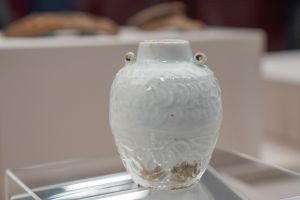
Pictured is a Qingbai glazed jar with two lugs and printed pattern from the Dehua kiln, bearing an ink inscription “Zheng Jin Ji Zhi Gui Mao Sui Ci” (Zheng Jinjin’s record in the Year of Guimao).  Unearthed from the “Nanhai I” shipwreck in 2018, the jar bears an ink inscription “Gui Mao Sui Ci” (the Year of Guimao). (Collection of the Guangdong Provincial Institute of Cultural Relics and Archaeology)
Pictured is a Qingbai glazed jar with two lugs and printed pattern from the Dehua kiln, bearing an ink inscription “Zheng Jin Ji Zhi Gui Mao Sui Ci” (Zheng Jinjin’s record in the Year of Guimao). Unearthed from the “Nanhai I” shipwreck in 2018, the jar bears an ink inscription “Gui Mao Sui Ci” (the Year of Guimao). (Collection of the Guangdong Provincial Institute of Cultural Relics and Archaeology)
Pictured is a brown glazed jar with four lugs and stamped characters “Chun Xi Shi Nian” from the Nanhai kiln in the tenth year of the Chunxi reign (1183) of the Southern Song dynasty.  Unearthed from the “Nanhai I” shipwreck in 2018, the jar bears the inscriptions “Chun Xi” and “Shi Nian” (the tenth year of the Chunxi reign). (Collection of the Guangdong Provincial Institute of Cultural Relics and Archaeology)
Pictured is a brown glazed jar with four lugs and stamped characters “Chun Xi Shi Nian” from the Nanhai kiln in the tenth year of the Chunxi reign (1183) of the Southern Song dynasty. Unearthed from the “Nanhai I” shipwreck in 2018, the jar bears the inscriptions “Chun Xi” and “Shi Nian” (the tenth year of the Chunxi reign). (Collection of the Guangdong Provincial Institute of Cultural Relics and Archaeology)
Pictured is a gem-set gold ring from the Southern Song dynasty (1127 – 1279), unearthed from the “Nanhai I” shipwreck in 2014. (Collection of the Guangdong Provincial Institute of Cultural Relics and Archaeology)
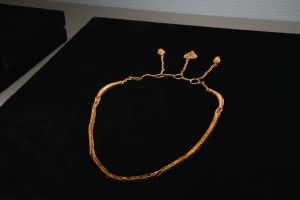
Pictured is a necklace with gold chain and rhinoceros horn-shaped cone ornaments from the Southern Song dynasty (1127 – 1279), unearthed from the “Nanhai I” shipwreck in 2014 (Collection of the Guangdong Provincial Institute of Cultural Relics and Archaeology).  The necklace features an intricate design, comprising a gold chain, two left-right symmetrical rhinoceros horn-shaped cone ornaments, a five-link clasp chain, and three tassels.  The tassels are attached with two pomegranate-shaped pendants and one peach heart-shaped pendant.  Both the design and form of the necklace are different from the mainstream Chinese styles in the Song dynasty.
Pictured is a necklace with gold chain and rhinoceros horn-shaped cone ornaments from the Southern Song dynasty (1127 – 1279), unearthed from the “Nanhai I” shipwreck in 2014 (Collection of the Guangdong Provincial Institute of Cultural Relics and Archaeology). The necklace features an intricate design, comprising a gold chain, two left-right symmetrical rhinoceros horn-shaped cone ornaments, a five-link clasp chain, and three tassels. The tassels are attached with two pomegranate-shaped pendants and one peach heart-shaped pendant. Both the design and form of the necklace are different from the mainstream Chinese styles in the Song dynasty.
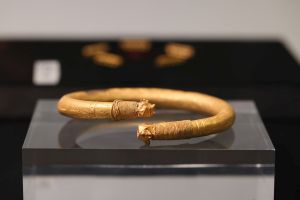
Pictured is a gem-set hollow gold bracelet from the Southern Song dynasty (1127 – 1279), unearthed from the “Nanhai I” shipwreck in 2014 (Collection of the Guangdong Provincial Institute of Cultural Relics and Archaeology).  The bracelet is made up of a main body and two opposing gem-set 14-faceted gold beads welded at the opening.  The gemstones are missing.  It is believed that the body of the bracelet was cast in a single moulding process.  Similar types of artefacts were previously excavated in Riyadh, Saudi Arabia.
Pictured is a gem-set hollow gold bracelet from the Southern Song dynasty (1127 – 1279), unearthed from the “Nanhai I” shipwreck in 2014 (Collection of the Guangdong Provincial Institute of Cultural Relics and Archaeology). The bracelet is made up of a main body and two opposing gem-set 14-faceted gold beads welded at the opening. The gemstones are missing. It is believed that the body of the bracelet was cast in a single moulding process. Similar types of artefacts were previously excavated in Riyadh, Saudi Arabia.

13 October, 2024

Back